Why Students Don't Pay Attention in Class Anymore
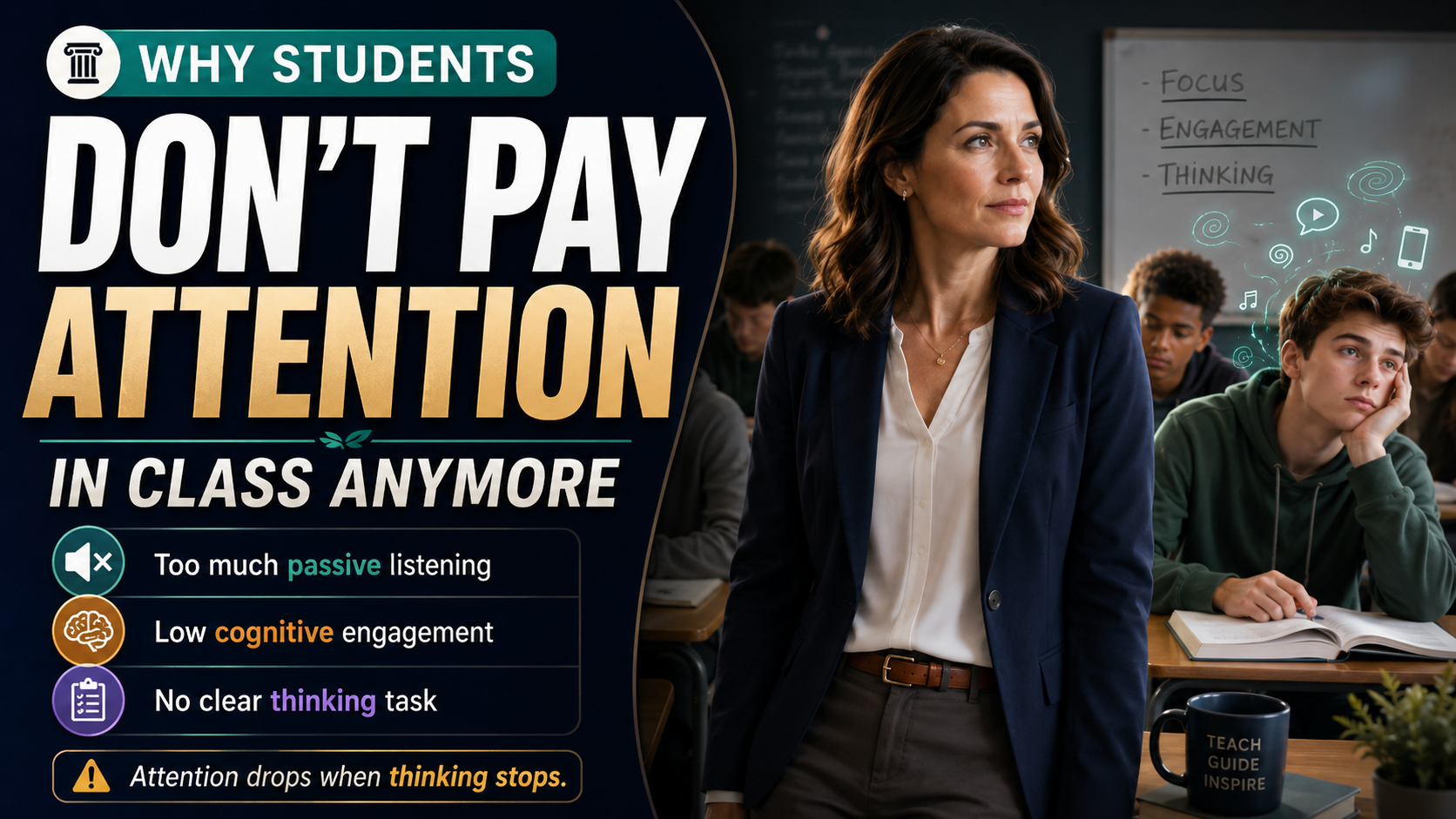
Quick Answer
Students are not simply becoming careless, lazy, or impossible to teach. Many classrooms are asking modern brains to sit through lessons that were designed for a slower, less interrupted world.Students are not simply becoming careless, lazy, or impossible to teach. Many classrooms are asking modern brains to sit through lessons that were designed for a slower, less interrupted world.
Key Takeaways
- 1
The attention economy has rewired how students manage focus — passive instruction is increasingly ineffective.
- 2
Attention during passive instruction declines sharply after 8-12 minutes.
- 3
Students disengage most when they cannot see a clear entry point into a task.
- 4
Attention is a design problem, not a discipline problem.
- 5
Breaking instruction into 10-minute blocks with student response points is one of the highest-impact changes a teacher can make.
The real attention problem is not just distraction
Students are not simply “less serious” than before. The deeper issue is that many classrooms are competing with a world that has trained children to expect speed, novelty, instant feedback, and low-friction stimulation, while school still often asks them to sit, listen, copy, wait, and somehow remain mentally present.
That gap is where attention collapses. A student may enter class already used to scrolling through short clips, switching between apps, replying to messages, gaming in quick reward loops, and consuming content that changes every few seconds. Then the lesson begins with a long explanation, a copied note, a board full of text, and no clear reason to care yet. The teacher sees disrespect. The student experiences mental drift.
This does not mean teachers must become entertainers. That is one of the most dangerous misunderstandings in modern education. The answer is not to turn every lesson into a circus. The answer is to design lessons that make attention necessary. Students pay better attention when the lesson gives their brains something specific to hold, test, connect, retrieve, question, or apply.
Attention is not something teachers beg for. It is something lesson design either protects or leaks.
When attention fails, the first question should not be, “What is wrong with these students?” The better question is, “Where exactly in the lesson did their thinking stop?” That single shift changes everything. It moves the conversation from blame to diagnosis.
Digital life has changed the attention habits students bring into class
Modern students are not only distracted by devices. They are shaped by them. Even when a phone is not visible, the habits built by digital environments can still follow the student into the classroom. Fast switching. Constant checking. Low patience for delayed meaning. Preference for quick answers. Discomfort with silence. A need for visible progress every few moments.
This matters because school learning often requires the opposite. Reading a difficult paragraph requires patience. Solving a maths problem requires holding steps in working memory. Writing an argument requires planning, drafting, revising, and resisting the urge to quit at the first sign of friction. Listening to a teacher explain a concept requires students to stay with meaning before the reward arrives.
Research on digital distraction keeps pointing to the same classroom truth: attention is fragile when students are surrounded by devices, notifications, and constant connectivity. A 2025 systematic review on digital distractions in education notes that students frequently use smartphones, tablets, and laptops for off-task purposes during instructional time, while constant connectivity contributes to “continuous partial attention.” :contentReference[oaicite:0]{index=0}
The digital world trains attention through immediate reward. Classrooms often demand delayed reward. That is not a small difference. It means teachers are not just teaching content; they are also rebuilding stamina for focused thought. A student who looks bored may not hate the subject. They may simply have weak endurance for sustained cognitive effort.
This is why phone policies matter, but they are not enough. Removing phones may reduce one source of interruption, but it does not automatically create a good lesson. A phone-free classroom can still be boring, overloaded, unclear, passive, or emotionally unsafe. The real work is both environmental and instructional: reduce avoidable distraction, then design learning that holds attention through meaning and action.
Students switch off when the lesson does not give them a role
One of the fastest ways to lose student attention is to make the teacher the only active person in the room. If the teacher explains, asks, answers, writes, corrects, interprets, and concludes while students mainly sit and receive, attention becomes optional. Some students will follow. Many will drift. A few will create their own stimulation through side conversations, jokes, tapping, wandering, or disruption.
Attention improves when students have a role inside the learning process. Not a decorative role. Not “Who can read number one?” Not “Are we together?” after ten minutes of talking. A real cognitive role means the student has to predict, compare, solve, retrieve, explain, choose, rank, defend, correct, or apply.
For example, instead of explaining a whole science concept and then asking if students understand, the teacher can pause after two minutes and say, “Write one sentence predicting what will happen if we remove heat from this process.” That tiny move changes the attention demand. Students are no longer just listening. They are processing.
- Passive lesson move: “Listen while I explain the causes of evaporation.”
- Active lesson move: “Look at these three situations and decide which one will evaporate fastest. Write your reason before we discuss.”
- Passive lesson move: “Copy this definition.”
- Active lesson move: “Use the definition to identify which example is wrong and explain why.”
- Passive lesson move: “Does everyone understand?”
- Active lesson move: “Show me with fingers: 1 means lost, 2 means partly there, 3 means ready to try alone.”
This is not just a nice teaching preference. It is strongly supported by learning research. A major meta-analysis published in Proceedings of the National Academy of Sciences found that active learning increased examination performance and reduced failure rates in science, engineering, and mathematics courses compared with traditional lecturing. :contentReference[oaicite:1]{index=1}
Active learning is not about keeping students busy. Busy hands can still hide empty thinking. The goal is not activity for activity’s sake. The goal is cognitive participation. Students need frequent moments where the lesson says, “Your mind is required here.”
Cognitive overload often disguises itself as poor attention
Some students stop paying attention because the lesson is not challenging enough. Others stop paying attention because it is too challenging in the wrong way. This is where cognitive load matters. Working memory is limited. When students have to process too many new words, steps, instructions, examples, visuals, and expectations at once, the brain protects itself by dropping pieces of the task.
In real classrooms, cognitive overload rarely announces itself politely. It may look like staring out the window, disturbing a neighbour, asking to go to the toilet, refusing to start, copying without thinking, or saying, “I don’t get it,” after the teacher has explained three times. The teacher may read this as laziness. But often, the student’s mental desk is simply full.
Cognitive load theory argues that learning is hampered when working memory capacity is exceeded during a learning task. That matters because attention is not separate from mental processing; if the task overwhelms the learner’s processing capacity, focus becomes harder to sustain. :contentReference[oaicite:2]{index=2}
Imagine a Year 6 maths lesson on fractions. The teacher introduces mixed numbers, improper fractions, conversion steps, a word problem, new vocabulary, and a worksheet all in one flow. Strong students survive. Average students begin copying patterns without understanding. Struggling students disappear mentally. They are present physically, but the task has exceeded their processing capacity.
The solution is not to lower expectations. It is to reduce unnecessary load. Teach one new move at a time. Model the first example. Remove irrelevant decoration from slides. Keep instructions short. Use worked examples before independent tasks. Check one step before adding the next. Give students language frames when the thinking is already hard.
- Clarify the learning target: What exactly should students understand or do by the end?
- Reduce split attention: Do not make students look at the board, worksheet, textbook, and verbal instruction at the same time unless necessary.
- Model the thinking: Show the decision-making process, not just the final answer.
- Pause for retrieval: Ask students to bring back what they learned two minutes ago, not just last week.
- Release gradually: Move from “I do” to “we do” to “you do” without rushing the middle stage.
When teachers manage cognitive load well, attention improves because students can actually stay inside the task. They are not drowning. They are climbing.
Students pay attention when retrieval becomes part of the rhythm
Many students lose attention because the lesson keeps moving forward while their memory is falling behind. The teacher introduces a new idea, explains it, gives an example, and moves to the next step. But the student has not yet pulled the first idea back into mind. The lesson is advancing, but the learner’s memory is not keeping pace.
This is why retrieval practice matters. Retrieval is not just “testing.” It is the act of making students bring learning back from memory. That action strengthens learning and gives attention a target. Instead of asking students to simply receive more information, the teacher asks them to recover, use, and connect what has already been taught.
Research reviews have found considerable evidence that retrieval practice can outperform restudying for later test performance, retention, inference, and transfer. In plain classroom language, students usually learn better when they are asked to remember and use knowledge, not only reread it or hear it again. :contentReference[oaicite:3]{index=3}
In a real lesson, this does not have to become complicated. After explaining a key idea, ask students to close their books and write the three words they remember. Before continuing a science experiment, ask them to predict the next step from memory. Before solving question four, ask them to explain why question two worked. At the end of the lesson, ask them to write the one mistake a student is likely to make tomorrow.
Retrieval protects attention because it interrupts passive drift. It tells the student, “You are not here to watch me know this. You are here to pull it back, test it, and make it yours.”
Emotional safety affects attention more than many teachers admit
A student who does not feel safe to be wrong will not fully pay attention. They may watch the teacher carefully, but not for learning. They are watching for threat. Will I be embarrassed? Will the class laugh? Will the teacher shout? Will my mistake become public? In that state, attention becomes defensive, not curious.
This is especially visible in discussion-heavy classrooms. Some students appear quiet and disengaged, but the real issue is not that they have nothing to say. They are calculating the social cost of speaking. If a classroom culture rewards only fast answers and polished confidence, slower thinkers learn to hide. Over time, hiding looks like apathy.
Teachers can build attention by building psychological safety into lesson routines. That does not mean lowering standards or accepting nonsense. It means designing participation so students can take intellectual risks without being crushed. Think-pair-share before whole-class answers. Mini-whiteboards before public responses. “Turn and rehearse your sentence first.” “Show me your attempt; I’m checking the strategy, not perfection.”
Correction also matters. A harsh correction may stop a behaviour quickly, but it can also teach the class that mistakes are dangerous. A better move is precise, calm, and instructional: “You used the right formula, but you substituted the wrong value. Go back to the question and underline the value we need.” That kind of correction keeps the student thinking.
Attention grows in classrooms where students believe effort will be guided, not mocked. If the emotional climate is tense, students will spend mental energy protecting themselves. If the climate is safe and structured, more of that energy becomes available for learning.
Attention improves when lessons have architecture
Many attention problems are really architecture problems. The lesson has content, but no shape. The teacher knows the topic, but students cannot feel the journey. There is no clear opening hook, no visible sequence, no participation rhythm, no check for understanding, no meaningful application, and no closing move that helps the learning stick.
Lesson architecture is the deliberate design of how learning unfolds. It answers the questions students may never say aloud: Why are we doing this? What should I pay attention to? What do I do with this information? How will I know I am getting better? What happens if I get stuck?
A strong lesson does not need to be flashy. It needs to be legible. Students should be able to sense the movement from introduction to explanation to practice to feedback to application. When that structure is missing, attention leaks through confusion, waiting time, weak transitions, overlong teacher talk, unclear tasks, and unplanned dead zones.
A simple attention-friendly lesson structure might look like this:
- Start with a problem: Present a question, error, image, short scenario, or misconception that makes the lesson necessary.
- Name the target: Tell students exactly what they will understand or be able to do.
- Teach in short cycles: Explain one key idea, then make students use it immediately.
- Check understanding early: Do not wait until the worksheet reveals failure.
- Give guided practice: Let students practise while support is still visible.
- End with retrieval or transfer: Ask students to recall, apply, or explain the learning without simply copying notes.
This structure protects attention because students are not left floating. They know where the lesson is going and what their minds should be doing at each point. Attention becomes easier when the classroom has rhythm.
School leaders should treat attention as a system, not a complaint
When attention becomes a school-wide concern, leaders often respond with behaviour talks, stricter rules, phone bans, warnings, or assemblies about seriousness. Some of those actions may be necessary. But if leadership only treats attention as a student character problem, the school misses the instructional pattern underneath.
A school that wants better attention should study lessons, not just students. Where do students drift most? During long explanations? During transitions? During independent work? During note copying? After break? In particular subjects? With particular task types? These patterns reveal whether the issue is behaviour, curriculum, pacing, lesson design, classroom routines, or teacher confidence.
Instructional coaching should include attention mapping. An observer can track what students are doing every five minutes: listening, writing, discussing, practising, waiting, confused, off-task, or copying passively. This gives teachers usable data without turning observation into judgement. The goal is not to shame teachers. The goal is to see where the lesson loses the room.
Professional development should also move beyond slogans like “make lessons engaging.” Teachers need practical design tools: how to reduce cognitive load, how to structure explanations, how to use retrieval practice, how to check understanding, how to plan transitions, how to create participation routines, and how to respond when attention drops.
The schools that will win the attention battle are not the schools that shout the loudest about discipline. They are the schools that build classrooms where attention has a job, a structure, a rhythm, and a reason to stay.
The next time students stop paying attention, do not rush to call them lazy. Look at the lesson moment where the mind had nothing clear to do, too much to hold, too little safety to try, or no visible path forward. That is where the repair begins. Not with louder teaching, but with sharper design.
::contentReference[oaicite:4]{index=4}
Practical Example
In a Year 8 English lesson on persuasive writing, the teacher noticed students drifting during the explanation of rhetorical devices. Instead of continuing with definitions, she placed three short campaign sentences on the board and asked students to rank them from weakest to strongest. They had two minutes to write one reason for their ranking. Then pairs compared answers before the class discussed. The room changed because students now had a decision to make. After that, she introduced ethos, pathos, and logos using the examples they had already judged. By the time students wrote their own persuasive sentence, they were not copying a technique blindly. They had already tested impact, defended a choice, and seen why the technique mattered. The attention problem reduced because the lesson moved from passive explanation to active judgement.
For Teachers
1. Audit one lesson this week and mark every moment where students are only listening or copying for more than five minutes. Add a quick-thinking task there: predict, rank, explain, retrieve, or correct an error. 2. Reduce your next explanation to one key idea, one modelled example, and one immediate student response. Do not explain five things before checking whether the first one landed. 3. Create a “safe attempt” routine. Let students first answer on mini-whiteboards, scrap paper, or with a partner before asking for public responses. This protects participation and reveals understanding faster.
For School Leaders
1. During lesson observations, track attention by lesson phase: opening, explanation, guided practice, independent work, transition, and closure. Look for where attention drops, not just who misbehaves. 2. Run a short staff development session on cognitive load. Ask teachers to bring one worksheet, slide, or lesson plan and simplify the instructions, examples, and task sequence. 3. Build a shared school routine for checking understanding. For example, every teacher uses exit tickets, hinge questions, mini-whiteboards, or quick retrieval prompts at least twice per lesson.
Frequently Asked Questions
Why do students not pay attention in class?↓
Students lose attention when lessons lack cognitive hooks, when teacher talk runs too long without interaction, or when tasks are unclear. These are design failures, not student character failures.
How long can students pay attention in class?↓
Research suggests sustained attention during passive instruction declines significantly after 8-12 minutes without interaction or response opportunities.
How can teachers improve student attention?↓
Break instruction into 10-minute blocks, require low-stakes responses frequently, activate prior knowledge before new content, and ensure every task has a clear entry point.
Free Weekly Newsletter
The Modern Teaching Brief
Every new article lands in your inbox the moment it is published.
Subscribe Free →