Classroom Management Is Not Discipline: It Is a System
Quick Answer
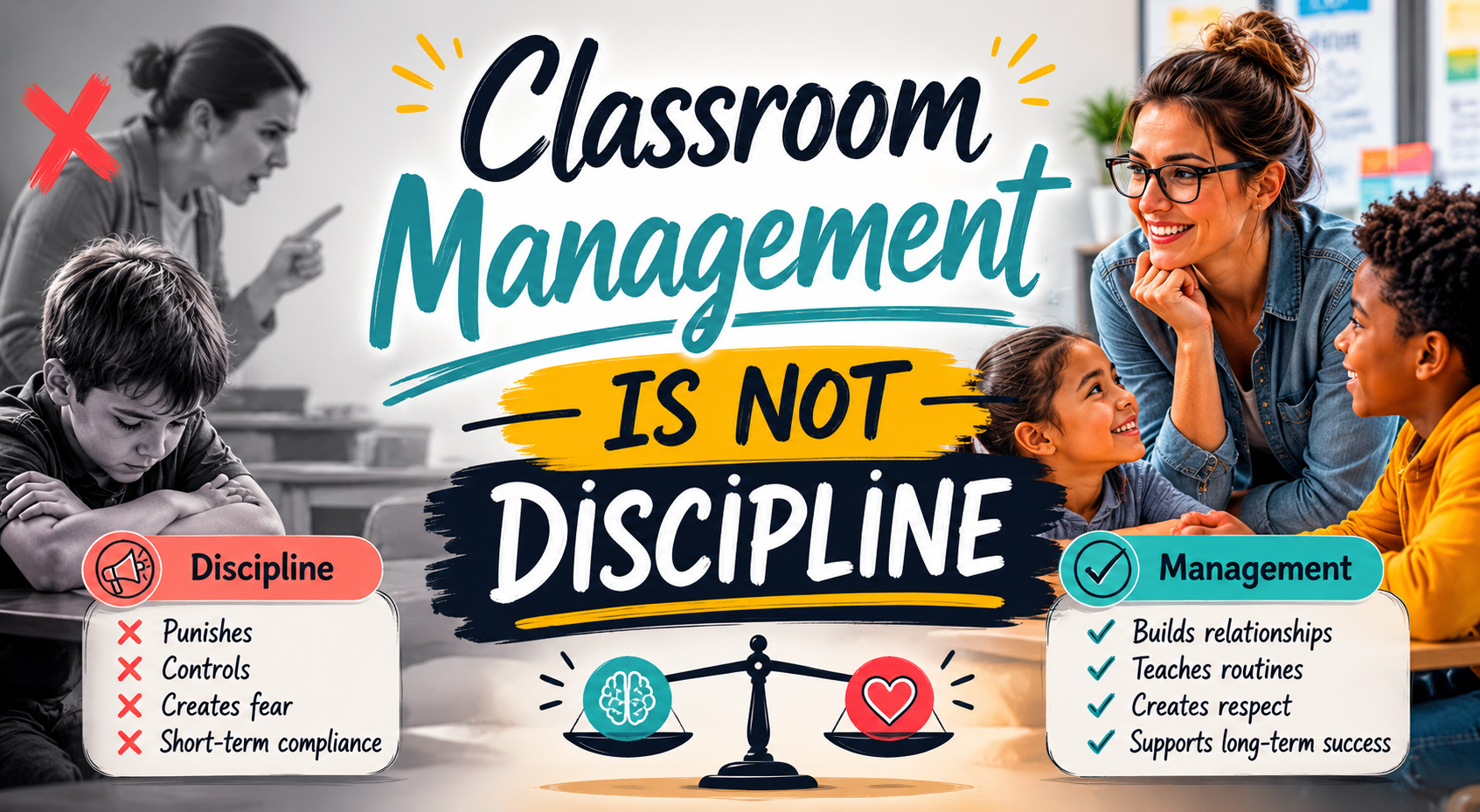
Classroom management is the system a teacher uses to create order, attention, participation, and learning before discipline is needed. Discipline responds to behaviour after it happens, but classroom management designs the environment so students know what to do, how to do it, and what happens next. Strong teachers build authority through clarity, consistency, routines, and instructional momentum, not constant correction.
Key Takeaways
- 1
Classroom management is infrastructure, not improvised reaction.
- 2
Reactive management exhausts teachers; proactive management prevents most incidents before they happen.
- 3
The four pillars are: Clear Expectations, Consistent Routines, Calm Authority, and Corrective Systems.
- 4
Authority is predictability and composure — not volume or threat.
- 5
Correction must be measured, consistent, and depersonalized to be effective.
The real problem is not that students are harder to control
The real problem is that many classrooms are being run on correction instead of design. A student talks while the teacher is explaining. The teacher corrects. Another student leaves a seat without permission. The teacher corrects. A group delays starting the task. The teacher corrects again. After forty minutes, the teacher is exhausted, the students have heard too many warnings, and learning has moved in broken pieces.
This is why classroom management must not be confused with discipline. Discipline is what a teacher does when behaviour has already moved out of line. Classroom management is the structure that makes the right behaviour easier, clearer, and more repeatable. One is response. The other is architecture.
Experienced teachers know this tension well. A class can look calm on Monday and become chaotic on Tuesday. The same students who behave well for one teacher may test another teacher within minutes. This does not always mean one teacher is naturally gifted and the other is weak. Often, it means one teacher has built a stronger operating system for the room.
A classroom is not just a space where teaching happens. It is a live social environment with movement, emotion, attention, fatigue, status games, peer influence, academic pressure, and dozens of decisions happening at the same time. If the system is unclear, students will fill the gaps with their own rules. If the system is strong, students borrow the teacher’s structure until it becomes the class culture.
Discipline reacts to behaviour; management prevents confusion
Discipline usually begins when something has gone wrong. A child refuses to work. A group becomes noisy. A student argues. Someone distracts others. The teacher then has to decide whether to warn, redirect, sanction, separate, ignore, report, or escalate. These decisions matter, but they are already late-stage classroom work.
Classroom management begins earlier. It asks: What should students do when they enter? How do they know the lesson has started? What does listening look like in this room? How do they ask for help? What happens when they finish early? How do we move from teacher talk to group work? How do we stop group work without shouting? What is the procedure when someone is stuck?
When these questions are not answered in advance, students improvise. Some improvise quietly. Others improvise loudly. Then the teacher labels the class as difficult, when the real issue may be that the classroom has no shared map.
A behaviour problem repeated daily is rarely just a behaviour problem. It is often a classroom system announcing where the procedure is missing, weak, or inconsistently enforced.
This is not an excuse for poor behaviour. Students still need boundaries, consequences, and accountability. But consequences without systems become a daily performance. The teacher keeps punishing the visible behaviour while the hidden cause remains untouched. A student who constantly calls out may need correction, but the class may also need a clear answer routine. A class that becomes chaotic during transitions may need consequences, but it also needs a rehearsed transition protocol.
The strongest authority is predictable, not loud
Some teachers mistake authority for volume. They believe control comes from a sharper voice, a stricter face, or a faster punishment. These tools may create short-term compliance, but they rarely build deep classroom authority. Students may obey in the moment while learning to wait for the teacher to become angry before they take expectations seriously.
Predictability builds a different kind of authority. When students know what the teacher means, what the routine requires, and what will happen if the routine is ignored, the teacher does not need to negotiate every moment. The room begins to carry the teacher’s expectations even before the teacher speaks.
This is why consistent teachers often appear calmer than everyone else. Their calm is not softness. It is structure. They have already decided what the entry routine looks like. They have a signal for attention. They know how they will respond to low-level disruption. They do not turn every offence into a public debate. Their authority is not coming from emotional pressure; it is coming from repeated patterns students can trust.
Students test adults partly to discover where the edges are. If the edges move daily, testing increases. If the edges are clear, students may still push, but they quickly learn that the system does not collapse because of mood, noise, excuses, or popularity. That is where real authority begins.
Classroom management is built from small repeatable routines
A strong classroom system is not one dramatic strategy. It is a collection of small routines that remove friction from learning. The mistake many teachers make is waiting for major disruption before they think about management. But most disruption begins in tiny moments: the first three minutes, the transition after an activity, the unclear instruction, the loose ending, the delay while books are being distributed, the vague “settle down” repeated ten times.
Good routines reduce the number of decisions students have to make. This matters because classrooms place heavy demands on attention and working memory. When students have to guess the task, the materials, the behaviour expectation, and the next step at the same time, some will disengage. Others will distract. A well-managed room lowers confusion so more mental energy can go into learning.
Useful classroom routines include:
- Entry routine: what students do in the first two minutes without waiting for repeated instruction.
- Attention signal: how the teacher gets the room back without shouting over students.
- Instruction routine: how students listen, check understanding, and begin work.
- Help routine: what students do when they are stuck before interrupting the teacher.
- Transition routine: how the class moves from one activity to another.
- Finish routine: what early finishers do so they do not become the source of disruption.
- Correction routine: how the teacher redirects behaviour without turning it into theatre.
The power is not in naming these routines once. The power is in teaching, modelling, rehearsing, and reinforcing them until they become normal. A routine that is only announced is still fragile. A routine that is practised becomes classroom memory.
Many discipline problems are lesson design problems in disguise
Classroom management does not sit outside lesson design. A weak lesson structure creates behaviour problems even when the teacher has good intentions. If the explanation is too long, attention drops. If the task is too easy, students drift. If the task is too hard, some shut down. If the transition is vague, noise expands. If the teacher gives five instructions at once, students remember two and invent the rest.
This is why experienced teachers should not only ask, “How do I discipline this class?” They should also ask, “Where is my lesson losing them?” Behaviour often rises where cognitive engagement falls. When students have nothing meaningful to think about, they will find something else to do. That “something else” may become talking, joking, wandering, arguing, or quietly disappearing inside themselves.
A well-managed lesson usually has instructional momentum. The teacher does not rush, but the lesson has movement. Students know the purpose, the task is broken into visible steps, checks for understanding happen early, and the teacher scans the room before confusion becomes resistance.
Here is a practical sequence teachers can use:
- State the learning target in student language. Avoid long curriculum language at the start.
- Model the task once. Show what quality looks like before asking students to produce it.
- Check understanding before release. Ask students to repeat the first step or identify the success criteria.
- Release in stages. Move from teacher model to guided practice to independent work.
- Scan early. Walk the room within the first two minutes of independent work.
- Correct the system first. If many students are stuck, pause and reteach instead of blaming effort.
This is where lesson architecture and classroom psychology meet. Students behave better when the learning path is visible. They are more likely to stay with the teacher when the teacher reduces uncertainty and keeps the task within reach.
Correction should protect learning, not entertain the room
One of the fastest ways to lose classroom authority is to turn correction into a public performance. A student misbehaves, the teacher stops the lesson, the class watches, the student responds, the teacher responds again, and suddenly the behaviour has become the main event. Even when the teacher “wins,” the lesson loses time, emotional energy, and momentum.
Strong correction is usually brief, calm, and connected to a known expectation. It does not require a speech every time. It does not need sarcasm. It does not need public humiliation. The goal is not to prove power. The goal is to return the student and the class to learning as quickly as possible.
This does not mean ignoring behaviour. It means choosing responses that do not reward disruption with attention. A teacher might use proximity, a quiet name, a hand signal, a private reminder, a seat change, a written reflection, or a consequence already explained before the lesson. The key is that the correction feels like part of the system, not the teacher’s emotional reaction.
When correction is predictable, students learn that the teacher is not bargaining with behaviour. The boundary is already set. The consequence is already known. The teacher can remain calm because the system is doing part of the work.
School leaders should stop judging management by silence alone
A silent classroom is not always a well-managed classroom. It may be controlled by fear, low challenge, passive copying, or student disengagement. At the same time, a noisy classroom is not automatically poorly managed. Productive discussion, practical work, peer explanation, and collaborative problem-solving can sound active while still being structured.
School leaders need a better lens. Instead of observing only whether students are quiet, they should observe whether routines are clear, transitions are smooth, instructions are understood, attention signals work, students know what to do when stuck, and the teacher can correct behaviour without derailing the lesson.
This shifts classroom management from personal charisma to professional practice. It also makes staff development more useful. Instead of telling a struggling teacher to “control the class,” leaders can help the teacher build an entry routine, script clearer instructions, rehearse transitions, redesign task flow, or develop a calm correction ladder.
The question is not, “Is this teacher strict enough?” The sharper question is, “What system is this classroom currently running on?” Once leaders ask that question, management becomes trainable, observable, and improvable.
The teacher who understands classroom management as a system stops chasing every behaviour as if it is a separate fire. They begin to study patterns. They notice when disruption happens, what happens before it, which routine is missing, and where the lesson loses cognitive grip. That is the shift. You are not simply managing children. You are designing the conditions under which attention, effort, respect, and learning become easier to repeat. A classroom without a system will always demand more discipline than any teacher has energy to give.
Practical Example
During a Year 7 English lesson on persuasive writing, the class became noisy every time the teacher moved from explanation to independent work. At first, she kept warning students to “settle down,” but the same pattern returned daily. She changed the system. Before releasing them, she modelled one sentence on the board, asked students to write the first five words in silence, then used a three-step start routine: pen down, eyes on task, first sentence started within one minute. She walked the room immediately instead of staying at the board. The first day was not perfect, but the noise dropped because students were no longer waiting in confusion. By the end of the week, most students began writing faster, and correction became less dramatic because the starting routine had become clear.
For Teachers
Choose one repeated behaviour problem this week and trace the system behind it. Do not begin with punishment; ask what happens before the behaviour appears. Then create one clear routine for that moment, such as how students enter, start work, ask for help, or move between activities. Teach the routine directly, model it once, rehearse it, and correct it calmly the same way for five consecutive lessons. Finally, reduce public correction. Use proximity, quiet reminders, and known consequences so the lesson does not become a stage for disruption.
For School Leaders
Observe classroom management through routines, not personality. During walkthroughs, note the entry routine, attention signal, transition process, instruction clarity, and how students begin independent work. In staff development, stop saying “be stricter” as if it is a strategy. Help teachers build shared routines, correction ladders, and lesson-start protocols that can be practised across year groups. Pair struggling teachers with strong system-builders, not just loud disciplinarians. The goal is to make classroom order teachable, repeatable, and visible across the school.
Frequently Asked Questions
What is classroom management?↓
Classroom management is the design of an environment that prevents most behavior problems through clear expectations, consistent routines, and calm authority — not just a set of reactions to disruption.
What is the difference between classroom management and discipline?↓
Discipline is a reactive response to behavior. Classroom management is the proactive system that makes most discipline unnecessary. Strong management reduces the need for disciplinary action.
How do you build a classroom management system?↓
Build on four pillars: teach clear expectations (not just rules), establish consistent routines, develop calm authority through composure and predictability, and create a measured, depersonalized corrective process.
Free Weekly Newsletter
The Modern Teaching Brief
Every new article lands in your inbox the moment it is published.
Subscribe Free →