AI for Teachers: What It Can Help With and What It Cannot Replace
Quick Answer
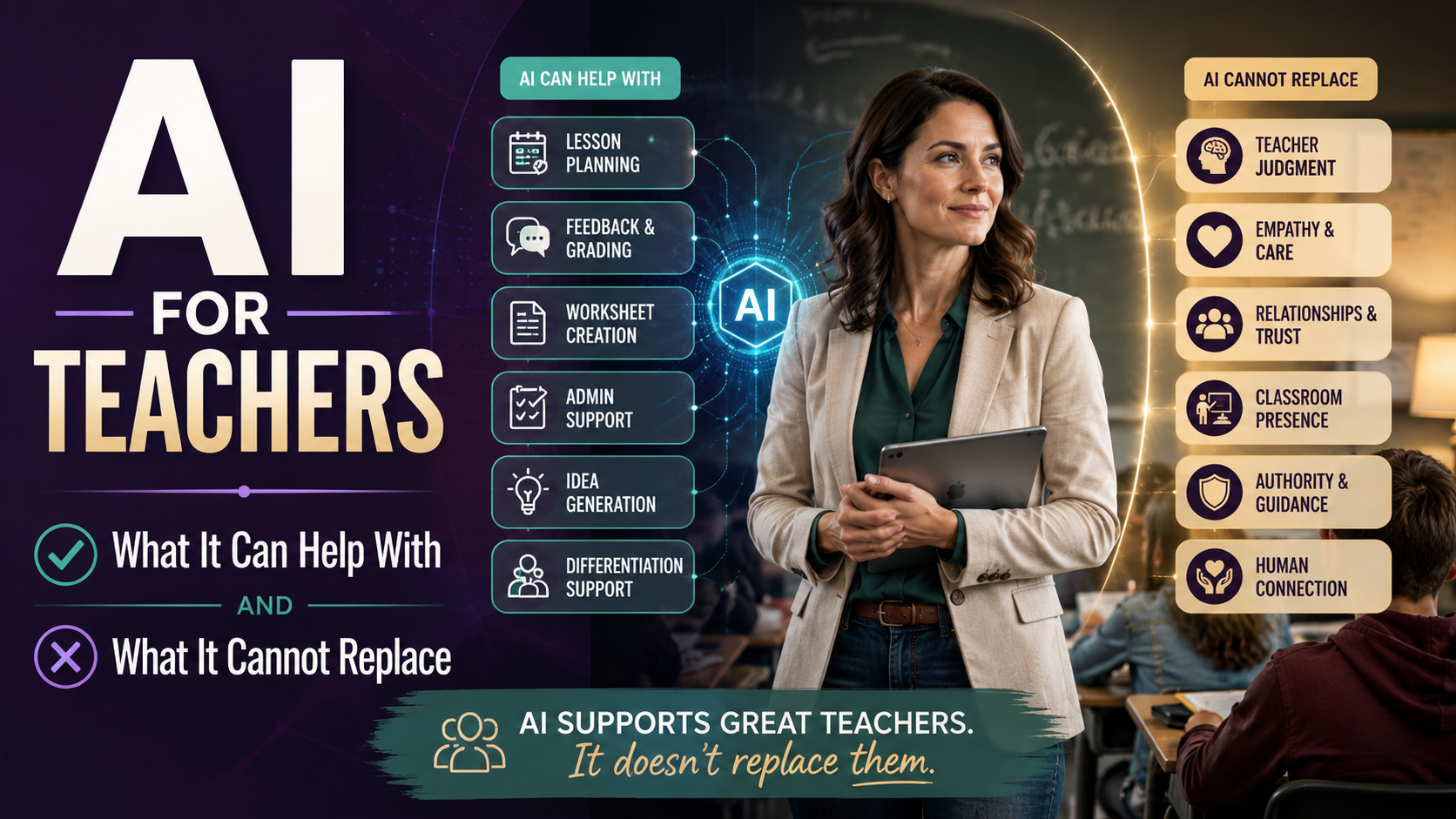
AI for teachers is useful for lesson planning, resource creation, differentiation, feedback support, assessment ideas, and administrative preparation. It cannot replace teacher judgement, classroom relationships, live decision-making, student trust, behaviour management, or the professional responsibility of knowing what learners need. The best use of AI is not to outsource teaching, but to strengthen the teacher’s planning system.
Key Takeaways
- 1
AI is genuinely useful for: lesson outlines, differentiation scaffolding, feedback drafting, and administrative writing.
- 2
AI shifts the teacher's role from content production to quality control and editing.
- 3
AI can create simplified, standard, and extended task versions in under a minute.
- 4
AI produces outputs. Teaching produces outcomes. They are not equivalent.
- 5
Presence, relationship, and professional judgment cannot be replicated by any AI tool.
AI is not the teacher. It is the planning room that never closes.
The real problem is not that teachers are lazy, outdated, or unwilling to plan well. The real problem is that teaching has become intellectually demanding, administratively heavy, emotionally intense, and painfully time-poor. A teacher is expected to plan lessons, differentiate for mixed abilities, prepare resources, mark work, track progress, manage behaviour, communicate with parents, attend meetings, support vulnerable learners, and still walk into the classroom with calm authority.
This is where the conversation around AI for teachers must become more honest. AI is not a magic wand. It will not suddenly turn a weak lesson into a great one if the teacher has no instructional clarity. It will not manage a difficult class. It will not sense when students are pretending to understand. It will not repair the emotional climate of a classroom after weeks of poor routines. But it can remove a serious layer of planning friction.
Used well, AI helps teachers think faster. It helps them generate options. It gives structure to scattered ideas. It can turn a lesson objective into a sequence, a topic into questions, a reading passage into differentiated versions, or a broad curriculum aim into teachable steps. That is not small. For a tired teacher planning at the end of a long school day, that can be the difference between guessing through tomorrow’s lesson and entering the classroom with a clearer route.
The mistake is treating AI as a replacement for teacher expertise. The smarter move is treating it as a planning partner. A partner that drafts, suggests, organises, challenges, simplifies, expands, and saves time. But the teacher still decides what is accurate, appropriate, ethical, engaging, and realistic for the students sitting in front of them.
AI can help teachers prepare the lesson, but it cannot inhabit the room. The room is still the teacher’s professional territory.
What AI can help teachers do better and faster
AI is strongest when the task involves language, structure, variation, examples, summaries, and pattern generation. That makes it useful for many parts of lesson planning. A teacher can ask AI to turn a topic into learning objectives, break a concept into smaller teaching steps, create starter questions, suggest misconceptions, design exit tickets, generate practice tasks, or produce a simple rubric.
For example, a Year 5 teacher planning a lesson on fractions can ask AI to create three explanations of equivalent fractions: one using pizza slices, one using number lines, and one using money. The teacher can then choose the explanation that matches the class. That is the key. AI offers options; the teacher applies judgement.
AI is also helpful for differentiation. Many teachers know they need to support struggling learners and stretch confident learners, but the planning time is often brutal. AI can generate a simplified version of a text, produce vocabulary support, create sentence stems, design challenge questions, and suggest scaffolded tasks. This does not remove the teacher’s responsibility, but it reduces the blank-page struggle.
Here are practical planning tasks AI can support:
- Turning curriculum objectives into student-friendly learning goals.
- Creating lesson starters, hinge questions, exit tickets, and plenary prompts.
- Generating examples, non-examples, analogies, and real-world applications.
- Producing differentiated worksheets or task versions for different ability levels.
- Creating rubrics for writing, projects, presentations, and practical work.
- Suggesting common misconceptions students may have about a topic.
- Drafting parent-friendly explanations of what students are learning.
The biggest benefit is not that AI creates everything perfectly. It does not. The benefit is that it gives the teacher something to react to. A rough draft is often easier to improve than an empty page. For many teachers, AI turns planning from construction into editing. That shift can save time, energy, and mental space.
What AI cannot replace in teaching
AI cannot replace the professional judgement of a teacher who knows the class. It does not know that the quiet child in the second row has stopped attempting written work because they are afraid of being wrong. It does not know that the whole class becomes restless after lunch unless instructions are shorter and more visual. It does not know that last week’s lesson failed because the students lacked background vocabulary, not because the activity was poor.
This matters because teaching is not just content delivery. Teaching is diagnosis. A good teacher is constantly reading the room: who is following, who is lost, who is copying without understanding, who is avoiding effort, who needs encouragement, who needs firmness, who needs silence, who needs a second example. AI can generate a lesson sequence, but it cannot interpret the living signals of thirty students in motion.
AI also cannot replace relationships. Students often work harder for teachers they trust. They take academic risks in rooms where mistakes are handled safely. They respond to correction differently when they believe the teacher is fair. No prompt can manufacture that kind of authority. It is built through consistency, tone, routines, feedback, emotional control, and time.
There is also an ethical boundary. Teachers are responsible for what they teach. If AI creates a misleading explanation, biased example, inaccurate historical detail, weak assessment question, or inappropriate reading level, the teacher cannot blame the tool. AI may support the work, but professional accountability remains with the adult.
AI cannot replace:
- Knowing the emotional temperature of the classroom.
- Building trust with students over time.
- Making live adjustments during a lesson.
- Choosing the right tone during correction.
- Understanding family, cultural, and school context.
- Spotting when students are compliant but not learning.
- Protecting children’s privacy and dignity.
This is why the strongest teachers will not be replaced by AI. But teachers who learn how to work intelligently with AI may become faster, sharper, and more prepared than those who ignore it completely.
The best AI prompts begin with teacher thinking
A weak prompt produces generic output. A strong prompt carries the teacher’s thinking into the tool. This is where many teachers get disappointed. They type, “Create a lesson on photosynthesis,” and receive a flat, textbook-style plan that could belong to any class in any school. Then they conclude that AI is overrated. The problem is not always the tool. Sometimes the problem is the missing instructional context.
Good lesson planning requires specificity. AI needs to know the subject, year group, time available, learning objective, prior knowledge, student ability range, classroom constraints, and desired outcome. Without those details, it guesses. And when AI guesses, it often produces safe, polished, average material.
A stronger teacher prompt might look like this:
Create a 45-minute Year 7 science lesson on photosynthesis for a mixed-ability class. Students already know plants need sunlight and water, but they confuse food with fertiliser. Include a 5-minute retrieval starter, a simple explanation, one visual activity, three hinge questions, one misconception check, and an exit ticket.
That prompt is powerful because it carries classroom intelligence. It tells AI what the teacher already knows. It gives the tool boundaries. It makes the output more usable. The teacher can then edit the lesson, sharpen the questions, remove unrealistic activities, and adapt the explanation to the class.
This is the central principle: AI does not remove the need for teacher thinking. It rewards it. The clearer the teacher’s thinking, the better the AI output. The weaker the teacher’s thinking, the more generic the output becomes.
A simple prompt structure teachers can reuse
- Context: State the year group, subject, class profile, and time available.
- Goal: State what students must understand or be able to do by the end.
- Challenge: State the misconception, difficulty, behaviour issue, or learning gap.
- Output: Ask for a lesson sequence, questions, activities, examples, rubric, or worksheet.
- Constraint: Specify the reading level, resource limits, lesson duration, or format.
That five-part structure turns AI from a content machine into a planning assistant. It also keeps the teacher in control. Instead of asking AI to “teach this topic,” the teacher asks AI to support a specific piece of instructional design.
How AI supports lesson architecture, not just lesson activities
Many teachers use AI to create activities. That is useful, but limited. The deeper opportunity is using AI to strengthen lesson architecture. A lesson is not strong because it has many activities. A lesson is strong because the parts connect. The objective leads to the explanation. The explanation leads to guided practice. The questions expose understanding. The task gives students the right kind of struggle. The feedback moves learning forward.
AI can help teachers test whether a lesson has that internal logic. A teacher can paste a lesson outline and ask, “Where does this lesson become confusing?” or “Which activity does not clearly support the objective?” or “What misconception might this task fail to reveal?” These are better questions than simply asking for more activities.
This matters because one of the biggest problems in classrooms is not lack of effort. It is instructional clutter. Teachers add videos, group work, games, worksheets, discussions, and projects, but the learning pathway is weak. Students may be busy, but not clearer. They may be entertained, but not more competent. AI can help teachers strip a lesson back to its learning spine.
For example, instead of asking AI, “Give me fun activities for teaching persuasive writing,” a stronger question would be, “Design a lesson sequence that helps Year 6 students understand the difference between a claim, a reason, and evidence. Include one teacher model, one guided practice task, one independent task, and three checks for understanding.” That request is not just about activity. It is about architecture.
Teachers can also use AI to improve questioning. Good questions are hard to write when tired. AI can generate retrieval questions, diagnostic questions, hinge questions, deeper discussion questions, and exit ticket questions. The teacher still needs to check quality, but the tool can speed up the first draft.
Better AI requests for lesson design
- “Identify the weakest part of this lesson sequence.”
- “Create three hinge questions that reveal whether students understand the main concept.”
- “Rewrite this activity so it checks understanding instead of just keeping students busy.”
- “Suggest likely misconceptions students may have before this lesson.”
- “Create a simpler explanation using concrete examples before abstract language.”
- “Turn this objective into a gradual release lesson: I do, we do, you do.”
Used this way, AI does not make teachers passive. It makes their planning more deliberate. It helps teachers ask better questions about their own lessons before students experience them.
What school leaders should do before pushing AI across the school
School leaders should not introduce AI as a shiny productivity trend. That creates noise. Teachers will experiment randomly, some will overuse it, some will fear it, and some will quietly ignore it. AI needs a school-level frame. The question should not be, “How do we get teachers using AI?” The better question is, “Which parts of our teaching and planning system can AI support safely and intelligently?”
A school should begin with boundaries. What can teachers use AI for? What should they avoid? How should student data be protected? Can teachers paste student work into AI tools? Should names be removed? Who checks accuracy? What counts as acceptable AI-assisted planning? These questions are not distractions. They protect professionalism.
Leaders also need to connect AI to existing instructional priorities. If the school is improving questioning, AI training should focus on generating better hinge questions and diagnostic prompts. If the school is improving writing instruction, AI can help teachers create models, rubrics, sentence stems, and feedback banks. If the school is improving curriculum consistency, AI can help departments design shared planning templates.
The worst version of AI implementation is tool-first. The best version is teaching-first. Start with the teaching problem, then use AI where it reduces workload or improves thinking.
- Set clear policy: Define safe use, data boundaries, checking expectations, and professional responsibility.
- Create shared prompt templates: Give teachers school-approved planning prompts aligned with your lesson model.
- Train through real tasks: Use actual lessons, not abstract demonstrations.
- Observe impact: Look for clearer explanations, better questioning, stronger scaffolds, and improved student work.
- Build staff confidence: Let teachers share before-and-after examples of AI-supported planning.
School leaders must also avoid using AI as another pressure tool. If the message becomes, “AI exists, so teachers should now do even more,” trust will collapse. The better message is, “AI should help us reduce waste, sharpen planning, and protect teacher energy for the work only humans can do.”
The teacher who wins with AI is still the teacher who thinks
The future does not belong to teachers who copy and paste the fastest. It belongs to teachers who can combine professional judgement with intelligent tools. A teacher who understands learning can use AI to plan faster. A teacher who understands misconceptions can use AI to design sharper questions. A teacher who understands classroom culture can use AI to prepare better routines, scripts, and explanations. But the thinking still has to come from the teacher.
This is the line that should guide every school: AI should reduce low-value workload, not reduce professional responsibility. It should help teachers prepare, not pretend to be teachers. It should support planning, not replace presence. It should make lessons clearer, not merely prettier. It should create time for the human work of teaching: noticing, responding, encouraging, correcting, explaining, listening, and leading.
There is a quiet danger in using AI badly. It can make average teaching look polished. A lesson plan may appear impressive on paper while still failing in the room. The slides may look clean, the objectives may sound refined, the worksheet may be formatted beautifully, but if the explanation is weak, the questions are shallow, and the teacher cannot respond to confusion, learning will still suffer.
So the action is not to fear AI or worship it. The action is to discipline it. Bring it into the planning process. Give it context. Ask it better questions. Challenge its first answer. Edit aggressively. Protect student privacy. Check accuracy. Use it to save time where time is being wasted, then reinvest that time into the parts of teaching that require human attention.
The teacher’s future is not built by refusing new tools. It is built by knowing exactly what the tool is for, what it is not for, and where the human must remain irreplaceable. AI can help plan the lesson in half the time. But the lesson still needs a teacher with eyes, judgement, courage, and a deep respect for the learners in front of them.
Practical Example
In a Year 6 English lesson on persuasive writing, the teacher noticed that students were using strong opinions but weak evidence. Before the next lesson, she used AI to generate three short model paragraphs: one with a clear claim but no evidence, one with weak evidence, and one with strong evidence linked to the claim. She edited the examples to match the class reading level and used them as a comparison task. During the lesson, students worked in pairs to rank the paragraphs and explain their choices. The teacher then modelled how to move from “I think school uniforms are good” to “School uniforms can reduce visible income differences because students are less likely to compare expensive clothing.” The outcome was immediate. Students stopped writing louder opinions and began adding reasons that actually supported their argument.
For Teachers
This week, choose one lesson you normally find difficult to plan and ask AI to create three possible lesson sequences, then combine the strongest parts into your own version. Take one worksheet or activity you already use and ask AI to create a simpler version, a standard version, and a challenge version for mixed-ability learners. Before teaching a new topic, ask AI for five likely misconceptions students may have, then turn those misconceptions into hinge questions you can use during the lesson.
For School Leaders
Choose one department and create a shared AI lesson planning prompt based on your school’s preferred lesson structure. During lesson observation, look for whether AI-supported resources are improving clarity, questioning, scaffolding, and student understanding, not just whether materials look polished. Run a 30-minute staff development session where teachers bring one real upcoming lesson and use AI to improve the objective, explanation, misconceptions, and exit ticket.
Frequently Asked Questions
How can teachers use AI?↓
Teachers can use AI most effectively for lesson planning, creating differentiated materials, drafting student feedback, and reducing administrative writing time.
Will AI replace teachers?↓
No. AI produces outputs. Teaching produces outcomes. Presence, relational intelligence, and professional judgment are irreplaceable human capacities that AI cannot simulate.
What are the best AI tools for teachers?↓
The most useful AI tools for teachers include ChatGPT, Claude, Gemini for general planning tasks, and purpose-built tools like Khanmigo, MagicSchool AI, and Diffit for education-specific workflows.
Free Weekly Newsletter
The Modern Teaching Brief
Every new article lands in your inbox the moment it is published.
Subscribe Free →